
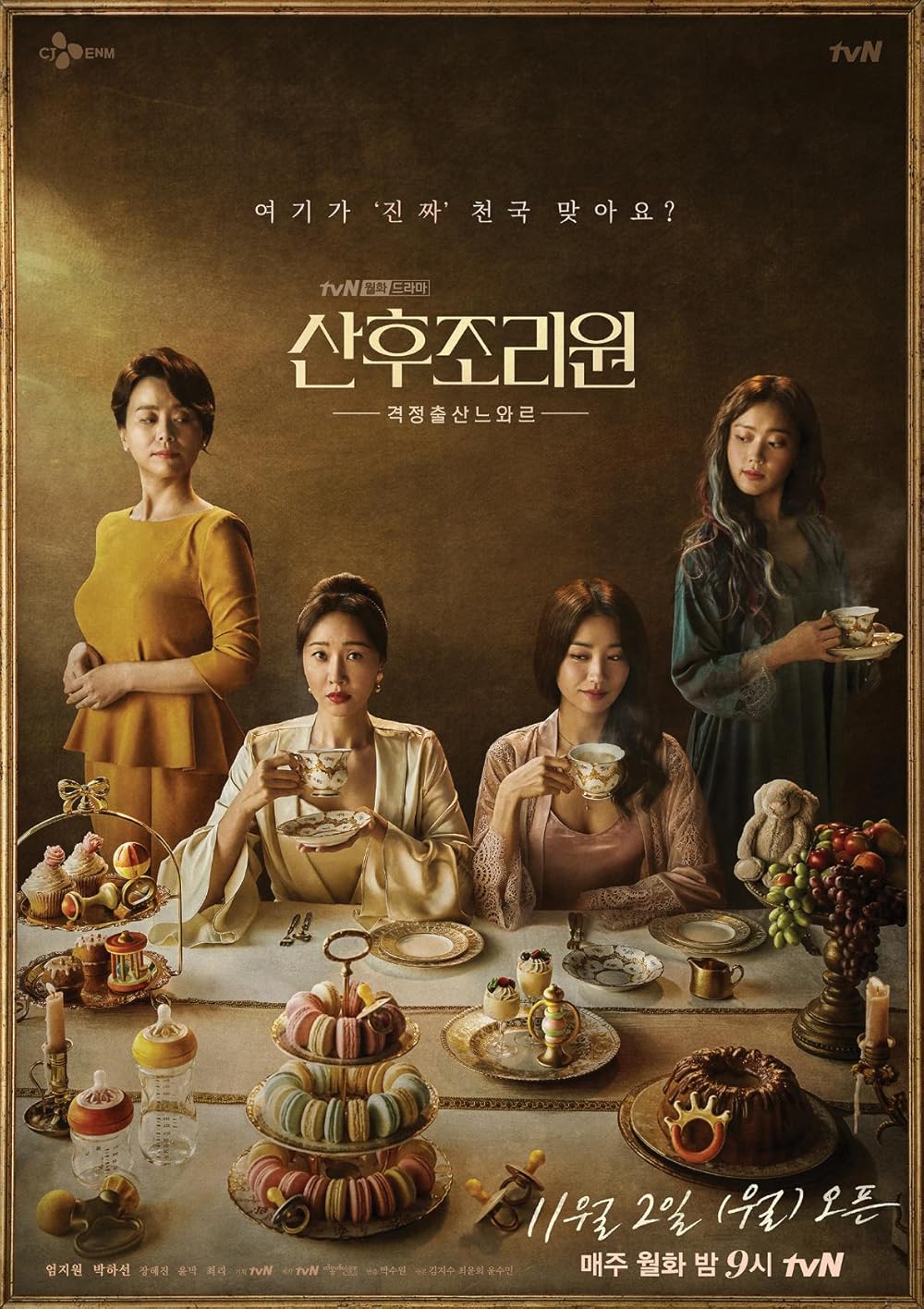
Hello, everyone! How are you doing? Today, I’m excited to share my thoughts on the drama Birthcare Center, which has become tvN’s intriguing and insightful look into modern motherhood, merging dark humor with sincere social commentary about women’s experiences in today’s Korean society.
Advertisements
Birthcare Center is a South Korean television series from 2020 featuring Uhm Ji Won, Park Ha Sun, Jang Hye Jin, and Yoon Park. It aired on tvN on Mondays and Tuesdays at 21:00 (KST) from November 2 to November 24, 2020, consisting of 8 episodes. Each episode lasts around 60 minutes, offering substantial character development and a satirical view of elite motherhood culture. The drama falls under the noir genre, delving into the realm of high-level postpartum care and providing a fresh lens on women’s narratives that are seldom depicted in Korean television.
At the peak of her career, a woman experiences the miracle of childbirth. She arrives at a postpartum care facility where she encounters both judgment and friendship. The series adeptly examines the conflict between career ambitions and motherhood, societal norms, and the intricacies of modern women’s lives, all while presenting the dark humor and social critique that have garnered critical acclaim. With a humorous take on a sensitive topic, Birthcare Center conveys a powerful message about the true essence of motherhood.
The Exclusive Postpartum Realm: Where Prestige Meets Fragility
Oh Hyun Jin is a successful businesswoman, yet she finds the experience of giving birth for the first time to be more challenging than she anticipated. She enters a prestigious postpartum care facility designed for society’s upper class. The narrative kicks off with the accomplished executive Oh Hyun Jin realizing that her numerous professional successes are insignificant when confronted with the realities of new motherhood in a high-end environment tailored for affluent women.
Oh Hyun Jin (Uhm Ji Won) is the youngest executive at her firm. After giving birth, she stays at a postnatal care center, becoming the oldest guest among the mothers and their newborns. The postpartum care center acts as a microcosm of Korean society, where wealth, status, and age create invisible hierarchies even among new mothers. The show skillfully utilizes this confined setting to delve into broader themes regarding women’s roles, societal expectations, and the pressure to excel as mothers while sustaining professional achievements.
Uhm Ji Won’s Stellar Interpretation of Oh Hyun Jin
Uhm Ji Won delivers a performance that defines her career as Oh Hyun Jin, embodying both vulnerability and resilience while navigating the most formidable transition of her life. The narrative revolves around Oh Hyun Jin (Uhm Ji Won), the youngest executive in her organization but the eldest mother at her opulent postpartum care center. Her performance encapsulates the disorientation of a highly accomplished woman who suddenly feels inadequate and lost in an area where her professional expertise is of no use.
Uhm Ji Won’s rapport with the ensemble cast fosters genuine moments of female camaraderie and support that are both humorous and profoundly touching. Her portrayal illustrates Hyun Jin’s transformation from a lonely, anxious new mother into someone who learns to embrace assistance and form authentic connections with other women facing similar challenges. The actress infuses nuance into every scene, enabling viewers to grasp the complexities surrounding modern motherhood expectations.
The Community: Park Ha Sun and Fellow Mothers
During her stay, she encounters other women, including Jo Eun-Jung (Park Ha-Sun), and they mature collectively. Park Ha Sun adds warmth and genuineness to Jo Eun Jung, crafting a character who acts as both a companion and a counterbalance to Hyun Jin’s perfectionist nature. The supporting mothers each reflect different facets of contemporary Korean womanhood, ranging from young wives to career professionals to affluent socialites.
I appreciate that the primary cast consists mainly of women, allowing the series to examine female relationships without the usual romantic subplot overshadowing the narrative. The interactions among the mothers yield some of the series’ most authentic moments, showcasing how shared experiences can bridge diverse backgrounds and forge unexpected friendships that assist women in navigating challenging transitions.
Elements of Dark Comedy: Critiquing Elite Culture
The series employs its lavish backdrop to satirize South Korean society’s fixation on status and perfection, especially regarding motherhood. The absurd regulations, competitive environment, and focus on appearances at the birthcare center provide ample fodder for dark comedy while illuminating serious concerns about women’s mental well-being and societal expectations.
Despite the sophistication of their surroundings, the mothers grapple with real challenges such as breastfeeding, postpartum depression, and familial expectations that wealth and luxury cannot alleviate. The show skillfully balances humor with emotional depth, never ridiculing the women’s authentic struggles while unveiling the absurdity of the systems meant to support them.
Personal Growth and Acceptance
The series culminates in a gratifying conclusion demonstrating how each mother has evolved through their collective experience at the center. Without revealing specific plot points, the final episodes illustrate that genuine support stems from understanding and embracing imperfection rather than chasing an unattainable ideal of motherhood.
In its concluding episode, the series achieved an average rating of 4.8% in the metropolitan area and 4.2% nationwide, with a total viewership of 1.1 million, marking its personal best. The series finale offers closure while emphasizing that motherhood is an ongoing journey of learning rather than a destination at which perfection is attained.
Achievements on tvN: Critical and Societal Influence
According to Nielsen Korea, Birthcare Center concluded with a national audience rating averaging 3.690% and 4.019% in metropolitan areas, indicating that viewers valued this distinct examination of women’s experiences. The series sparked extensive cultural conversations about expectations surrounding motherhood, the balance between career and family, and the support systems necessary for women during significant life changes. Birthcare Center took over tvN’s Monday & Tuesday 21:00 time slot, formerly held by “Record of Youth,” and followed by “Awaken,” solidifying its status as essential viewing for audiences seeking authentic narratives centered on women. The show’s success highlighted that Korean viewers craved realistic portrayals of motherhood that transcended conventional romantic or familial drama tropes.
The Ideal Modern Motherhood Experience
If you enjoy stories focused on women, dark comedies with emotional depth, and series that intelligently address real social issues, Birthcare Center is the ideal show to binge on Netflix and other streaming services. This series is not merely entertainment; it is a thoughtful exploration of contemporary womanhood that will evoke laughter, tears, and provoke deep reflection on the pressures women encounter in modern society.
Why This Motherhood Comedy Is Worth Your Attention
Birthcare Center stands out because it treats its female characters with genuine respect and depth, steering clear of both sentimentality and cynicism while delivering authentic moments that resonate with women’s real-life experiences. The series presents an ideal mix of social commentary and entertainment, demonstrating that the best humor arises from an honest exploration of life’s most challenging transitions.
Series Overview
Number of Episodes: 8
Platform: tvN
Release/End Year: 2020
Rating (IMDb): 7.4/10
Genre: Dark Comedy/Women’s Drama
Status: Completed
Main Characters: Uhm Ji Won (Oh Hyun Jin), Park Ha Sun (Jo Eun Jung), Jang Hye Jin (supporting mother), Yoon Park (supporting character)
Antagonist: Societal expectations and motherhood pressures (no traditional antagonist)